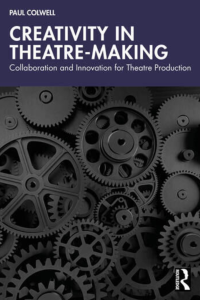
My book is out now, published by Routledge. It is about how theatre-makers like myself, my colleagues and students, think of our relationships with each other and how some of this thinking causes obstacles that impede effective theatre-making. I propose that the root cause of most of these problems is when theatre-makers’ relationships are perceived to be hierarchical. In a small number of ways they are, but this causes many more problems than it occasionally solves. In other ways, our relationships are simply not hierarchical, and I explain why the perception that they are causes issues.
I am an academic, but the book is not loaded down with referencing and I hope it is not stuffy. It is intentionally not styled like an academic journal article. I feel that reams of citations will not help most of my intended readership to learn. On the contrary, I think it would put off many people that I would most like to reach.
I attempt to take an overview of the collective needs and concerns of everyone who works backstage. Given the great diversity of backstage roles I have probably bitten off more than I can chew and I anticipate some people disagreeing with me! I welcome this. My intention is to stimulate thinking and reflection on some of the pressing challenges the theatre industry faces, like recruitment and retention, environmentally sustainable practices and backstage bullying. If nothing else, disagreeing with me will hopefully help readers to clarify their own thoughts.
The best solution to problems caused by hierarchical theatre-making is to be found in the area that mostly causes the hierarchy to exist. It is perpetuated mainly by a misunderstanding of creativity. This is where I begin setting out my case, by looking at the nature of creativity in theatre-making. I set the scene for understanding the driver of hierarchical attitudes between theatre-makers, which is the division of roles into two groups – ‘creative’ and ‘technical’. I outline all the major ‘backstage’ roles, then introduce the resources they typically work with and how these are often mistakenly thought of as constraints. I show how this attitude can impact creativity and have unhelpful knock-on effects upon collaboration.
Having set out who theatre-makers are and, as you may discover, challenged ideas about which ones are creative and which are technical, in the middle of the book I tackle obstacles that get in the way of making theatre. I start by challenging theatre-makers’ relationships being understood within a pyramid-shaped hierarchy. This structure fails to convey the complex layers of responsibility which exist across the whole theatre production team and inhibits access to creativity. I offer a heterarchical model as a stronger basis for understanding team relationships. I then examine aspirations and possibilities in theatre production, with a particular emphasis on the way ideas are communicated between those who generate them and those who are tasked with bringing them into reality. Miscommunication and misunderstanding usually revolves around the deployment of resources, so I suggest strategies for collaborating with time, people, and money, to minimise the risk of conflict. I include observations on giving and receiving feedback, highlighting where a number of common practices and conventions obstruct teamwork. Much of the collaboration between theatre-makers is also predicated on assessments of what can and cannot be achieved. These assessments must factor in risks, especially financial and health & safety risks, which influence every aspect of theatre-making. I propose strategies to enable all theatre-makers to share a solid foundational understanding and be able to engage in each of these areas.
The connections between risk, feedback, heterarchies and creativity all come together in meetings between theatre-makers. Towards the end of the book, I offer a selection of tools that can be utilised to improve the quality and outcome of meetings. Some of these are near universally applicable, such as agendas and minutes, and some are more industry-specific, such as particular uses of drawings and models. I then explain each of the major meeting classifications that are distinctive to many fields of theatre-making; these are ‘Feasibility’, ‘White Card’, ‘Modelbox’, ‘Production’, and ‘Notes’ meetings.
In the final chapter, I summarise my key ideas, bringing them together into one location for easy future reference. I also indulge in a little speculation about some of the broader issues of the theatre industry, in the hope of leaving readers with some parting food for thought and of provoking debate beyond the confines of the book.
Creativity in Theatre-Making is available now in all fine bookshops. My fellow academics can request an inspection copy direct from Routledge.